Project Overview & Architecture
# ADVANCED ANPR & FRS SOLUTION
**Team:** Coding Brigades
**Hackathon:** KAVACH — National Cybersecurity Hackathon
**Project Focus:** ANPR · OCR · Face Detection · Face Recognition · Real-Time CCTV Analytics
## Project Brief
**ADVANCED ANPR & FRS SOLUTION** is an intelligent traffic-enforcement platform designed to perform **Automatic Number Plate Recognition (ANPR)** and **Facial Recognition (FRS)** from CCTV feeds, with a specific focus on recognizing **non-standard number plates** that vary in font, size, design, symbols, and formatting.
The project was developed by **Team Coding Brigades** for the KAVACH hackathon. Our team consisted of six members, and we submitted two problem definitions, with **both solutions being shortlisted**. This project was selected for the final stage, where we travelled to **Mumbai/Panvel** for the final round.
The core objective was to strengthen the **One Nation, One Challan** concept by connecting vehicle identification with driver identification rather than relying only on the registered vehicle number.
**My Role:** Machine Learning & Backend Developer — owning the model integration, Flask backend, database layer, end-to-end inference pipeline, performance optimization, mobile integration, and Git workflow.
## Problem Statement
Traditional ANPR systems work effectively with clearly formatted number plates, but real-world Indian roads contain a large variety of **non-standard plates** with different fonts, layouts, sizes, symbols, languages, and visual conditions.
This creates two fundamental challenges:
**Vehicle Identification**
Detect and recognize a vehicle's number plate even when the plate does not follow standard formatting.
**Driver Identification**
A number plate identifies the vehicle, but not necessarily the person driving it. A vehicle may be shared, borrowed, stolen, or associated with an incorrect identity.
The system therefore needed to establish a complete chain:
**CCTV → Vehicle → Number Plate → Plate Text → Driver Face → Identity**
The challenge was to make this pipeline work reliably across **different lighting conditions, camera angles, image quality, plate formats, and real-world CCTV footage**.
## Solution Architecture
The solution was designed as a multi-stage computer-vision pipeline where each model performs a specialized task.
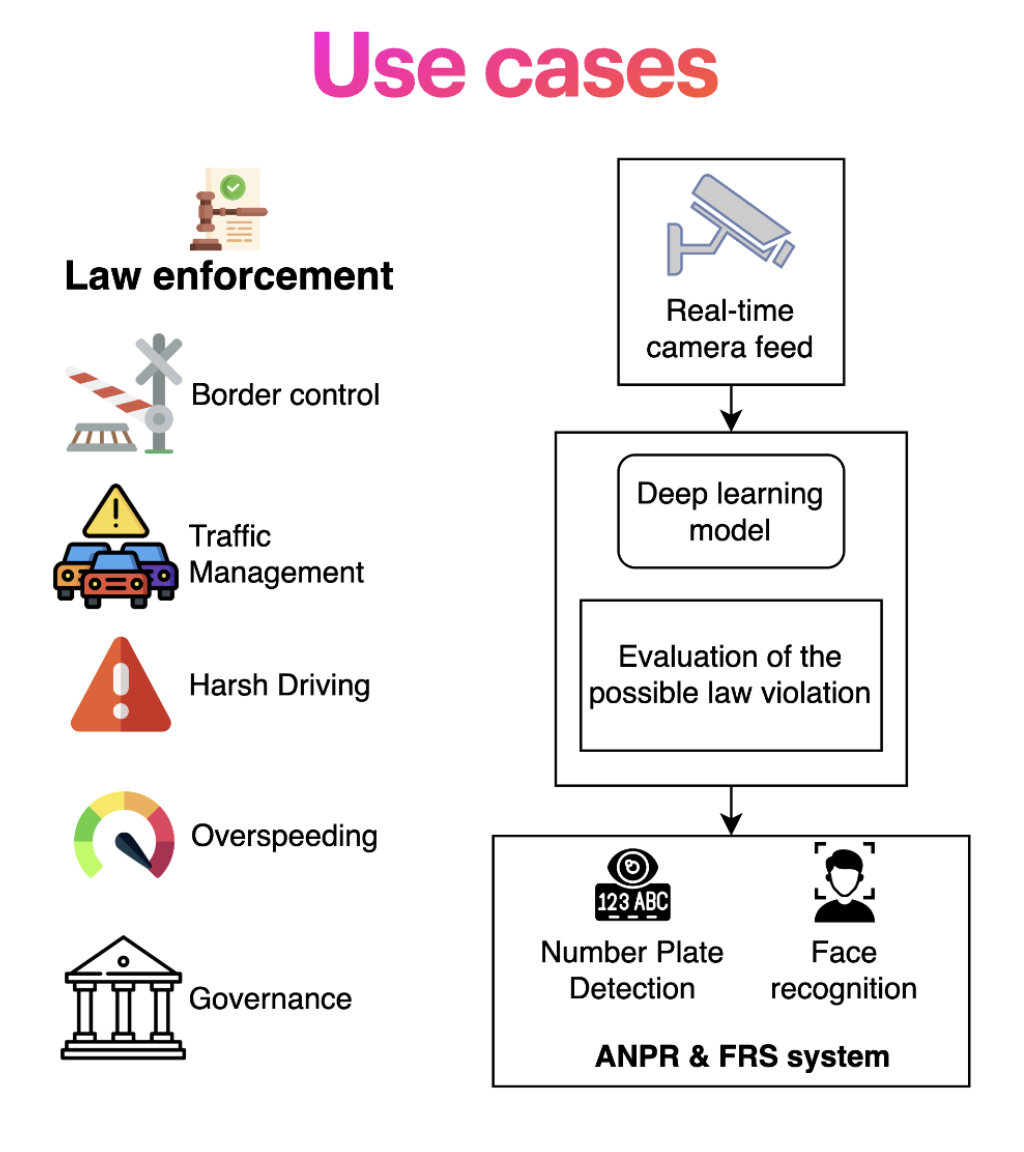
*System use case diagram — actors, operations, and the boundary between the field application and the inference backend.*
### Image-Based Flow
**Mobile / CCTV Image**
↓
**Vehicle & Number Plate Detection**
↓
**Plate Classification**
↓
**OCR Processing**
↓
**Standard / Non-Standard Identification**
In parallel:
**Vehicle Image**
↓
**Driver Face Detection**
↓
**Face Recognition**
↓
**Identity Matching**
Both pipelines converge at the backend, where the results are processed and delivered to the administrative application.
### Core Architecture
* **YOLO-based models** for vehicle, driver, and number-plate detection.
* **YOLOv8 and YOLO-NAS** evaluated and used for detection tasks.
* A dedicated **OCR pipeline** operating on the detected plate coordinates.
* Separate **face-detection and face-recognition stages**.
* **Flask APIs** acting as the central inference and application layer.
* **MongoDB** for fast and flexible data storage.
* **Flutter mobile application** for government/admin users.
* Real-time processing support for **CCTV feeds**.
*System architecture — detection, OCR, recognition, and backend orchestration as independently replaceable stages.*
The most important architectural decision was to keep **detection, OCR, recognition, and backend orchestration as separate stages**, allowing each component to be independently improved without redesigning the complete system.
## Technical Execution
I owned the central integration of the system, bringing the individual ML components together into a single operational pipeline.
### Dataset & Model Development
For face detection and recognition, we created our own dataset by collecting face images from controlled environments, including classroom settings. The dataset contained approximately **5,000–6,000 face images**, which were used for training and evaluating the recognition pipeline.
For number-plate detection, we initially created a dataset by capturing **2,000+ vehicle images** from college parking areas under different lighting conditions, camera angles, distances, backgrounds, and image contrasts.
The images were manually annotated for number-plate detection.
To improve real-world accuracy, we later collaborated with the **Ahmedabad Municipal Corporation** to obtain CCTV footage from different traffic locations. We developed a preprocessing script to extract frames from the footage at regular intervals, creating an additional dataset of **14,000+ real-world number-plate images** with significantly greater environmental diversity.
### Detection & OCR Pipeline
* Trained multiple YOLO-based detection models.
* Used **YOLOv8 and YOLO-NAS** for detection experiments.
* Built a dedicated number-plate detection model.
* Developed the OCR processing stage after plate detection.
* Passed the detected plate coordinates directly into the OCR pipeline.
* Extracted plate text from the detected region.
* Classified the detected plate as **standard or non-standard**.
* Improved the model using real-world CCTV data, achieving approximately **98% detection accuracy** on the final evaluation.
### Backend & Integration
* Designed and developed the central backend using **Python Flask**.
* Integrated the face-detection, face-recognition, number-plate detection, and OCR models.
* Designed the MongoDB data layer.
* Built APIs for mobile and administrative applications.
* Managed the complete **image → inference → result → response** workflow.
* Optimized the execution sequence to minimize processing overhead.
* Reduced the overall image inference and response pipeline to **under 300 ms** in the developed system.
### Mobile Application
I also developed the **Flutter-based mobile application** for government/admin users.
The workflow was intentionally simple:
**Capture / Upload Image → Process → Detect Vehicle → Detect Plate → Extract Text → Detect Face → Recognize Driver → Display Results**
The application acts as the operational interface for the backend computer-vision pipeline.
### Real-Time CCTV
The same pipeline was integrated with **live CCTV feeds**, allowing the system to process frames continuously and detect number plates and driver faces during runtime.
I also managed the **Git branching, integration, and overall development flow** across the different components of the project.
## Results & Impact
The project transformed separate computer-vision models into a **single integrated traffic-analysis platform** capable of connecting vehicle information with driver information.
### Key Outcomes
* Developed a dedicated solution for **standard and non-standard number-plate recognition**.
* Built a real-world dataset of **14,000+ CCTV-derived plate images**.
* Created an additional **2,000+ manually annotated vehicle/plate dataset** during initial development.
* Developed a face dataset containing approximately **5,000–6,000 images**.
* Achieved approximately **98% number-plate detection accuracy** after training with diverse real-world data.
* Integrated **ANPR + OCR + Face Detection + Face Recognition** into one pipeline.
* Achieved **<300 ms inference/response time** for the developed image-processing workflow.
* Built a Flutter application for government/admin users.
* Integrated the pipeline with live CCTV processing.
* Successfully connected the complete flow from **image acquisition to actionable identification data**.
The project was submitted to **KAVACH**, where our team submitted two problem definitions and **both were shortlisted**. This solution progressed to the final round in **Mumbai/Panvel**.
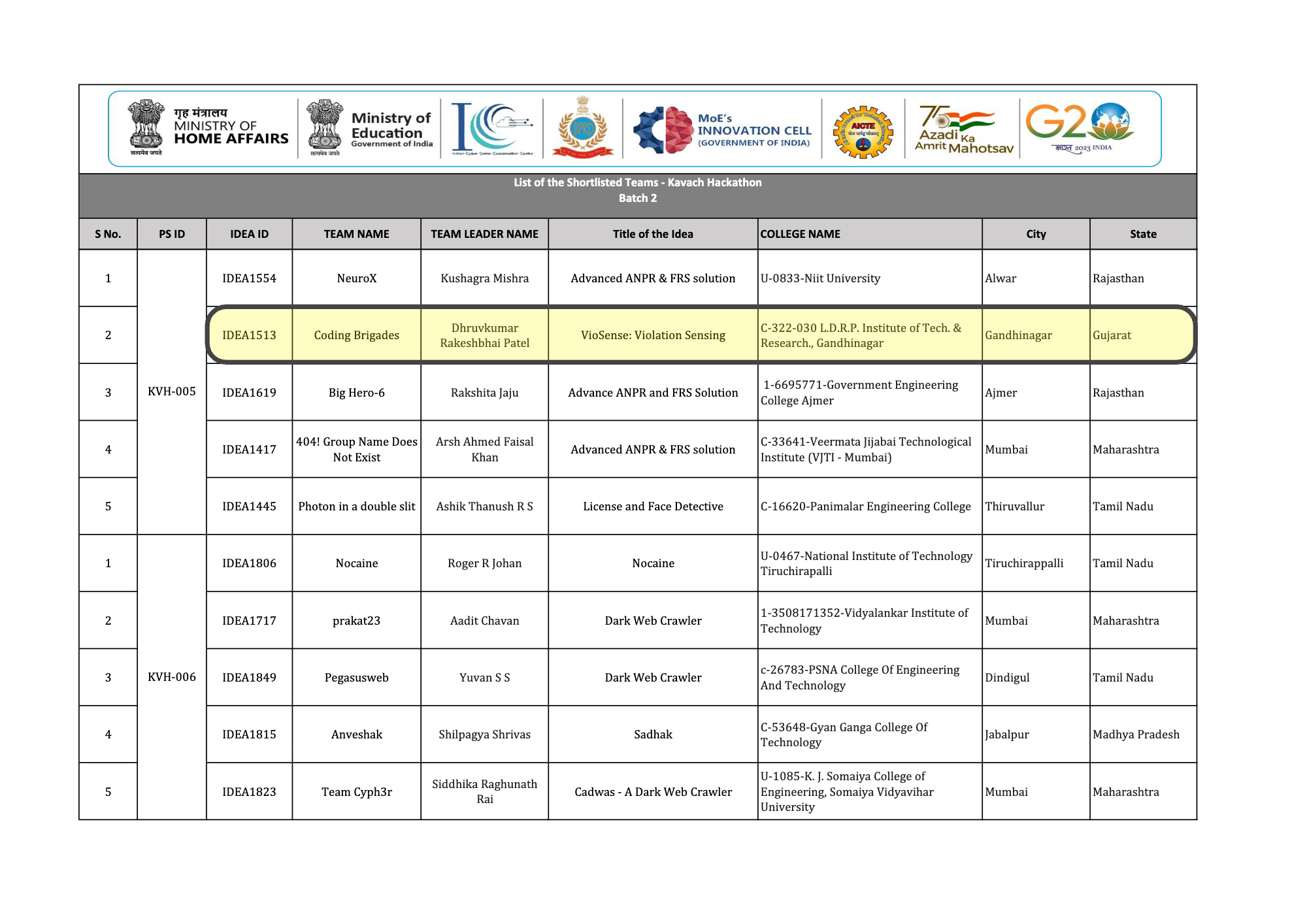
*KAVACH national shortlist — problem statement one.*
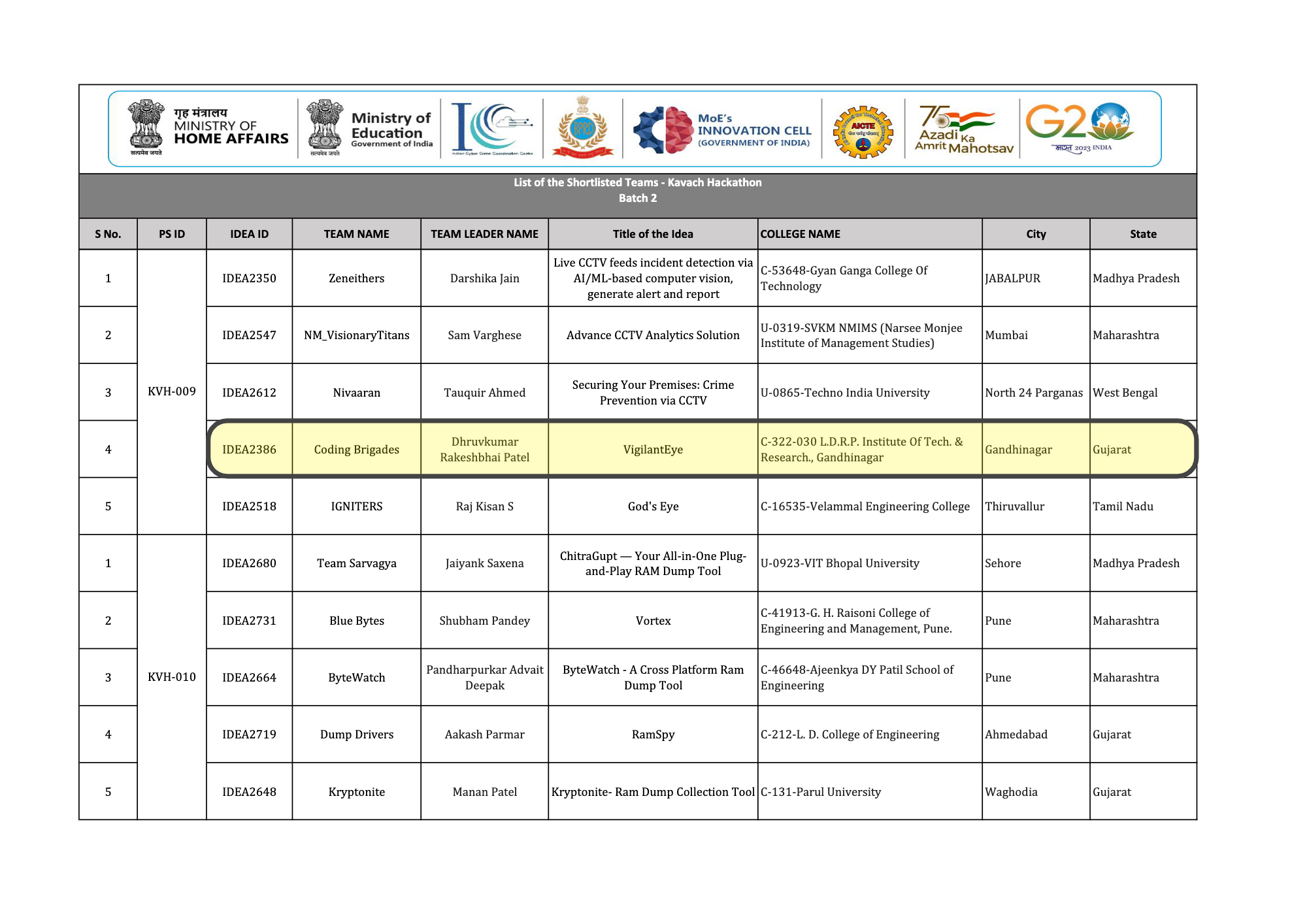
*KAVACH national shortlist — problem statement two. Both submissions from Team Coding Brigades were selected.*
Although we did not win the final round, the experience exposed us to real-world engineering constraints, live requirements, rapid feature changes, time pressure, team coordination, and technical decision-making under demanding conditions.
## Key Learnings
This project significantly strengthened my understanding of building **end-to-end computer-vision systems rather than isolated ML models**.
The most important lessons were:
* Real-world ML performance depends heavily on **dataset diversity and quality**.
* CCTV systems require models to handle **lighting, angle, resolution, occlusion, and environmental variation**.
* Separating **detection, OCR, recognition, and orchestration** makes complex systems easier to improve and maintain.
* Model accuracy alone is not enough; **inference latency and system integration** are equally important.
* A successful ML product requires strong coordination between **models, APIs, databases, mobile applications, and deployment workflows**.
* Real-time hackathon development taught me how to handle changing requirements without losing focus on the core architecture.
* Working as the central integration owner improved my ability to distribute work, manage Git branches, resolve integration issues, and maintain the complete technical flow.
* The experience reinforced the value of designing systems with **flexibility for future model improvements and new requirements**.
Most importantly, the project taught me how to move from **raw data → trained models → optimized inference → backend APIs → mobile application → real-world decision support**, which became one of the strongest practical computer-vision experiences in my early engineering journey.